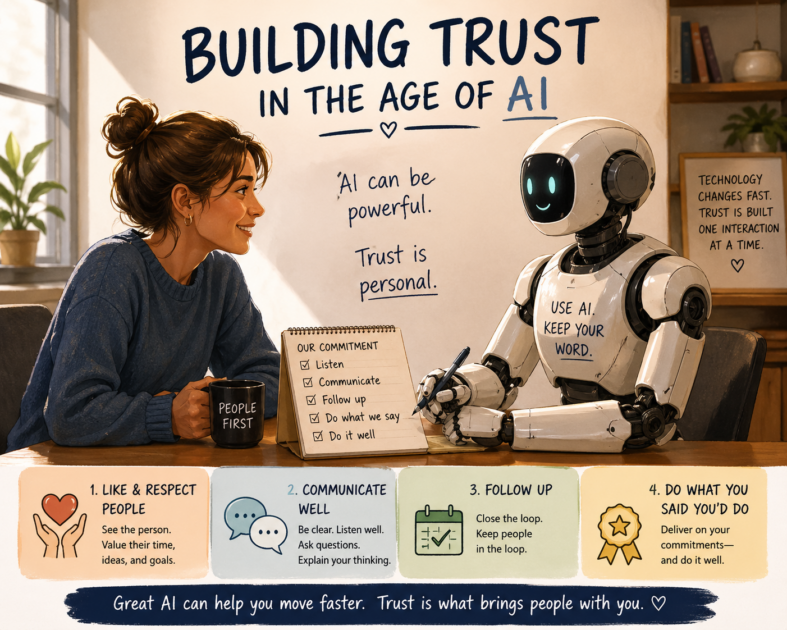
Being trusted by your colleagues and clients has always been important.
In this “age of AI”, people and relationships still matter.
Trust is what differentiates one product manager from another. Trust is what gets someone assigned an important task, gets them a wider scope of work, gets them a promotion or a job referral.
Here are some areas to consider when looking to build trust with your team and beyond.
Like & Respect Your Colleagues
Like and respect the people you are talking to. They will be able to tell if you don’t.
Find something to like. If you don’t like someone initially, that’s ok. Think about an aspect of them you do like. Maybe they’re argumentative and difficult, but you realize that sometimes they’re right to push back, and they help make the group’s decisions stronger as a whole.
Everyone deserves respect. They’re in the room and at the table (literally or metaphorically) for a reason. If you don’t know why they’re there, that’s something you should figure out. Understanding everyone’s role is critical for good communication. Which brings me to…
Communication, communication, communication
Most items must be communicated multiple times. The rest of your team, your company, and your clients are not focused on the same items day-to-day that you are.
Jargon, acronyms, tech talk: If you explain a term to a client once, make sure you repeat that explanation at least several more times. They may have understood it initially, but after a week goes by focusing on other items, they may have forgotten. You may want to be seen as an expert, but be one who educates and brings everyone along, not someone spouting meaningless acronyms.
The ‘why’ behind the what: If you’ve told your product team why a feature must be built, tell them again. And again. If anyone on your team is left wondering ‘why are we doing this?’, it’s a good sign you haven’t told them why often enough. Trust may erode if the team doesn’t understand the ‘why’ behind the work.
If something changes after a meeting and you need to let someone know, make sure you do that promptly. Which brings me to…
Follow Up & Do Quality Work (no AI slop)
Do what you say you’re going to do, and do it well.
Timeframes: If you promise to do something in a certain timeframe, make sure to complete it within that timeframe. If you can’t, then communicate an update (“I am not able to get x done by y; it’s looking like I’ll have it done by z instead.”)
Use AI thoughtfully: If you use AI to create a deliverable, such as a document or ticket for developers, read it over at least a few times to ensure it makes sense. For example, I noticed a document that a colleague created defined the same term three times within two pages. As another example, I wrote a policy page with the help of AI; I took another look at it recently when a colleague mentioned they might use AI to summarize it. I realized it was far longer than it needed to be, so I added a ‘tl;dr’ at the top and removed anything unnecessary.
What Else?
What else is critical to building trust? What do you focus on, or have seen others do successfully?
—-
P.S. I’m torn on using AI to generate images, knowing so many of the training images were likely copyright. On the other hand, it’s a cute pic that I “created” with one prompt 🤔 What’s your line? Do you use AI for image generation? Is it any different than using AI for other purposes?